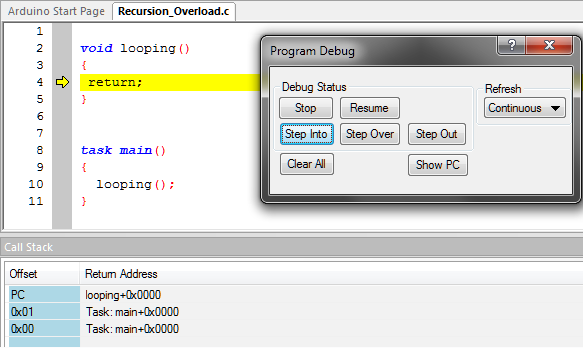
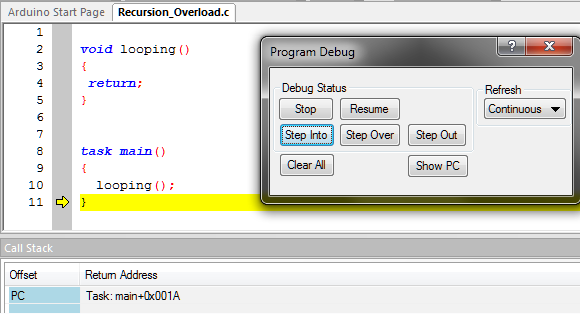
Memory Overload
| One of the major issues that can arise when utilizing recursion is memory overload. This occurs when the onboard memory of a computer system or microprocessor is filled beyond maximum, or 'overloaded'. |
|
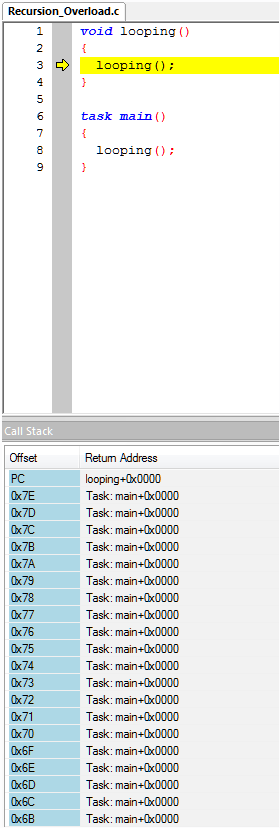
In the next example, we have simply placed a recursive call in 'looping' back to itself before the 'return' command. Now, each time 'looping' is called it reaches the recursive command first and opens up another copy of the function in memory.
Since the program flow is directed to the new calling of the function before the return command or a closing brace is reached, each function remains open in memory. |
|
|
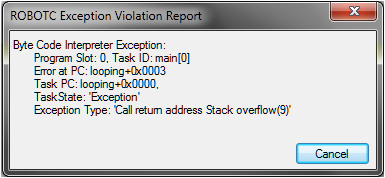
This very quickly overloads the memory and causes a crash.
|
|
Controlled Recursion
|
To use function recursion without running into a memory overload issue, the function must be set up to exit at some point. This can be done a variety of ways.
|
|
One such possibility is to set up a simple if-else statement that checks a condition and 'returns' if one of the conditions are met.
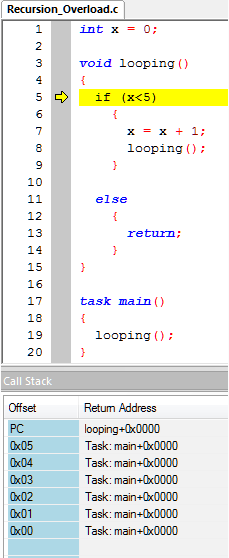
In the example below, the if-else statement checks to see if the integer variable x (which starts with a value of 0) is less than 5. If it is, x is incremented by one and the function calls itself again. This process repeats until x is no longer less than 5 (the else statement), at which point the function ends and program flow returns to where the function was originally called from. |
|
|
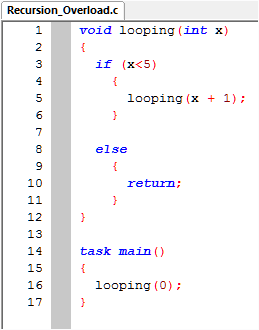
A variant of this program that also works is to utilize parameters. By creating 'looping' with the integer x as its parameter, we can pass a value of 0 from task main and increment the value of x when it is passed to a new copy of looping every time recursion occurs.
|
|
Ending Functions
|
If the above programs are manually stepped through, there will be 5 steps to go through before task main is returned to.
Remember, each time a function is called it opens another 'copy' of the function. Those extra steps are for the first, second, third, and fourth copies of the 'looping' function. The functions only clear out of memory when their end brace '}' or a return command is reached. |